Updated July 2026.
To create a gallery wall, first choose a common thread (palette, theme, or frame style), arrange the frames on the floor, then hang them from the center outwards. Maintain a consistent spacing of 5 to 8 cm and center the entire arrangement at eye level, around 150 to 160 cm from the floor.
What is a gallery wall?
A gallery wall, or framed wall, brings together several posters, paintings, or photos composed together on the same wall. Well-orchestrated, it transforms a bare wall into a focal point of the room, tells a story, and gives a sense of a lived-in, personal interior. Poorly executed, it can quickly become a mess: everything depends on the method.

Step-by-step: creating your gallery wall
The key to a successful wall is to prepare everything before drilling. Follow this order:
- Choose a common thread: a shared palette, a theme (botanical, abstract, black and white photos), or the same style of frames. This is what unifies the whole.
- Gather your pieces and first lay them out on the floor to test combinations without commitment.
- Trace the outline of each frame onto kraft paper, cut it out, then tape the templates to the wall to validate the full-scale composition.
- Start from the center: first hang the central piece, then progress outwards, maintaining regular intervals.
- Check for levelness as you go; a crooked frame is immediately noticeable.
At what height and spacing should you hang?
A few numerical guidelines prevent most placement errors:
| Situation | Guideline |
|---|---|
| Height of the center of the composition | 150 to 160 cm from the floor (eye level) |
| Above a sofa or furniture | 20 to 30 cm between the furniture and the first frame |
| Spacing between frames | 5 to 8 cm, consistent throughout the arrangement |
| Width of the composition | maximum two-thirds to three-quarters of the furniture's width |
On a large wall, a 5 cm spacing makes the composition tighter and denser; beyond 8 to 10 cm, the arrangement breathes more but can become scattered.

Three compositions that always work
Depending on the desired effect, three structures stand out:
- Symmetrical grid: identical frames aligned in equal rows. Orderly and graphic, it suits minimalist interiors.
- Linear alignment: a row of frames aligned to a common high or low line. Perfect above a sofa or along a hallway.
- Organic composition: varied formats distributed around a center, with constant intervals. More free, it requires careful balancing of masses.
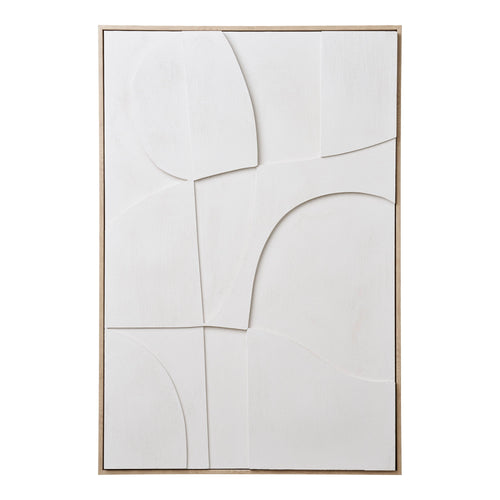
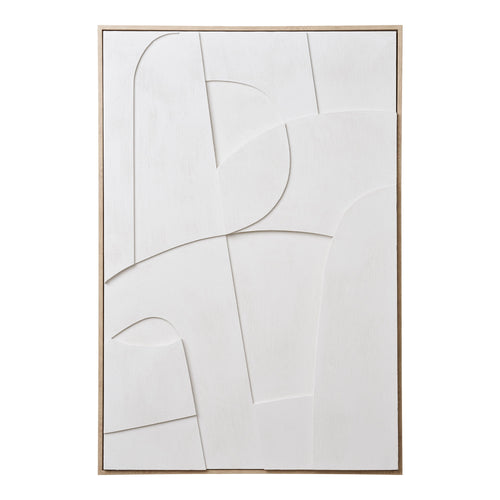
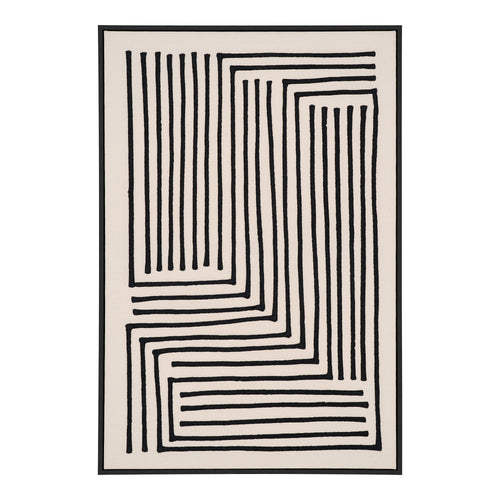
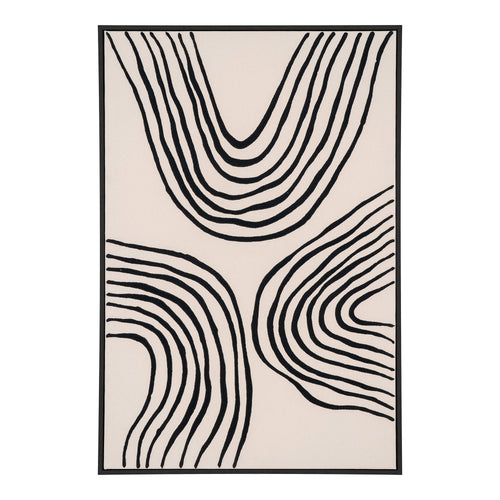
- Same frame color (all black, all light wood, all gold) to tie together varied visuals.
- Same illustration palette to unify different frames.
- Ready-to-hang sets: a coordinated set of three frames instantly solves the coherence issue.

Choosing coherent frames
You can mix formats and orientations, as long as you maintain a common theme. Safe bets include:
Fenalor's tip: Before drilling, live with your paper templates taped to the wall for a few days. This helps you spot imbalances in different lighting, and adjust without making multiple holes. Find your visuals in our wall art and frames.
Choosing the right wall and lighting it
Not all walls are suitable for a composition. The ideal candidate is a wall that is discovered upon entering or sitting down, clear for at least 1.50 m wide, and without a doorway or light switch in the middle. Avoid walls crossed by the grazing light of a side window: it accentuates the slightest level defect and causes glass to reflect. Reflection is, in fact, the main enemy of a gallery wall. Facing a window or an illuminated screen, glossy glass becomes a mirror and obscures the image: prefer matte or anti-reflective glass, or prints without glass. For lighting, two adjustable wall sconces placed 30 or 40 cm on either side of the composition reveal it much better in the evening than a central ceiling light that flattens everything. Our guide details which wall sconce to choose and where to place it.
Formats and margins: the detail that makes the difference
A composition rarely fails because of the frames, more often because of the formats. Two simple guidelines are enough. First, avoid all identical formats outside a strict grid: an organic composition requires at least three different sizes to breathe, with a ratio of about one to two between the smallest and the largest. Then, don't neglect the passe-partout, the cardboard margin between the image and the frame. A generous margin, 5 to 8 cm for small formats and up to 10 cm for large ones, isolates the image, gives it space, and makes the whole look more refined. A print glued edge-to-edge in its frame always seems more ordinary. Last point: match the orientation of the composition to that of the wall. A wide wall calls for horizontal spread, a narrow wall or a stairwell for vertical progression.
Frequently Asked Questions
At what height should a gallery wall be hung?
Center the composition at eye level, about 150 to 160 cm from the floor to the middle of the arrangement. Above furniture, leave 20 to 30 cm between the top of the furniture and the bottom of the first frame, to visually connect the two without crowding them.
What spacing should be left between frames?
A regular interval of 5 to 8 cm works in most cases. Tighter, around 3 to 5 cm, the whole appears compact and graphic; wider, beyond 8 to 10 cm, it breathes but risks scattering. The main thing is to maintain the same spacing throughout.
Can different sized frames be mixed?
Yes, and this is even what gives rhythm to an organic composition. For the mix to remain harmonious, maintain a common thread: the same frame color or a shared illustration palette. Distribute larger formats towards the center and smaller ones on the periphery.
How to hang without damaging the wall?
For light frames, clean-removable adhesive strips avoid drilling. For heavier pieces or those framed under glass, prefer hooks suitable for the weight and type of wall. Always test the arrangement with paper templates before fixing.
To decorate your walls, explore our wall art and frames and all of our decorations. To compose around them, also read our rules for arranging wall shelves.